
Last updated 18 August 2026 by Sammie O, owner of Bud Car Wash in Ras Al Khor Industrial Area 2, Dubai.
Two cars can look equally dull but need very different treatments. The choice between paint correction vs polishing depends on whether the finish has light haze and swirls or defects that reach deeper into the clear coat.
Polishing can restore gloss with limited abrasion. Paint correction uses a more controlled abrasive process to reduce or remove paint defects, but every correction removes some clear coat. Knowing the difference helps you improve your vehicle’s finish without chasing damage that cannot be fixed safely.
Want us to do it instead?
We do detailing and surface protection at our Ras Al Khor bay, 24 hours a day. Fill this in and we reply with a price and a time. The message writes itself, so you only tap send.
Would rather talk? Call +971 55 168 5050. Someone answers 24 hours.
What paint correction actually does
Paint correction is a controlled process that improves the surface of a vehicle’s clear coat. It isn’t a new layer of paint, and it doesn’t hide every defect. A machine polisher, pad, and compound or polish remove a small amount of material around a mark, allowing the panel to reflect light more evenly.
Most factory-painted panels have a color coat covered by a clear protective layer. Swirl marks, light scratches, oxidation, and some water-spot etching sit in or affect this upper surface. When the defect is shallow enough, careful correction can reduce or remove it.
A professional detailer begins with an inspection under strong lighting. The paint is washed, dried, and checked panel by panel before the abrasive product is selected. This matters because a dark hood with fine swirls needs a different approach from a faded roof with damaged clear coat. The common auto detailing paint defects guide provides useful visual examples of these conditions.
How clear coat removal works
Think of a scratch as a shallow valley in the clear coat. To remove the visible mark, the surrounding high points must be leveled until the surface is close to the bottom of that valley. A finishing polish may be enough for light haze, while compound or wet sanding removes material more quickly.
Every pass has a limit. A good detailer uses a test spot first, checks the result, and stops when the finish has reached a safe improvement. The goal isn’t to remove every visible mark at any cost. The goal is a cleaner, glossier finish with enough clear coat left for future maintenance.
What correction cannot safely fix
A scratch that reaches the color coat, primer, or metal cannot be safely polished away. Clear coat failure, peeling paint, stone chips, and deep gouges usually need touch-up work or repainting.
If a scratch catches your fingernail, polishing may soften its edges, but complete removal may require more clear coat than the panel can safely lose.
Severe oxidation also needs careful inspection. Surface oxidation can often be improved, but failing or peeling paint won’t become stable through polishing. A professional should explain the likely result before work begins.
Paint correction vs polishing: the practical difference
The terms overlap because polishing is often one part of paint correction. In simple terms, polishing is usually the lighter treatment, while correction describes the wider process of defect reduction.
The exact service name can vary between detailers. A package called “wax and polish” may involve hand application, a light machine polish, a glaze, or a protective product. Ask what the service includes before booking. The word “polish” alone doesn’t confirm that scratches or swirls will be removed.
What polishing does
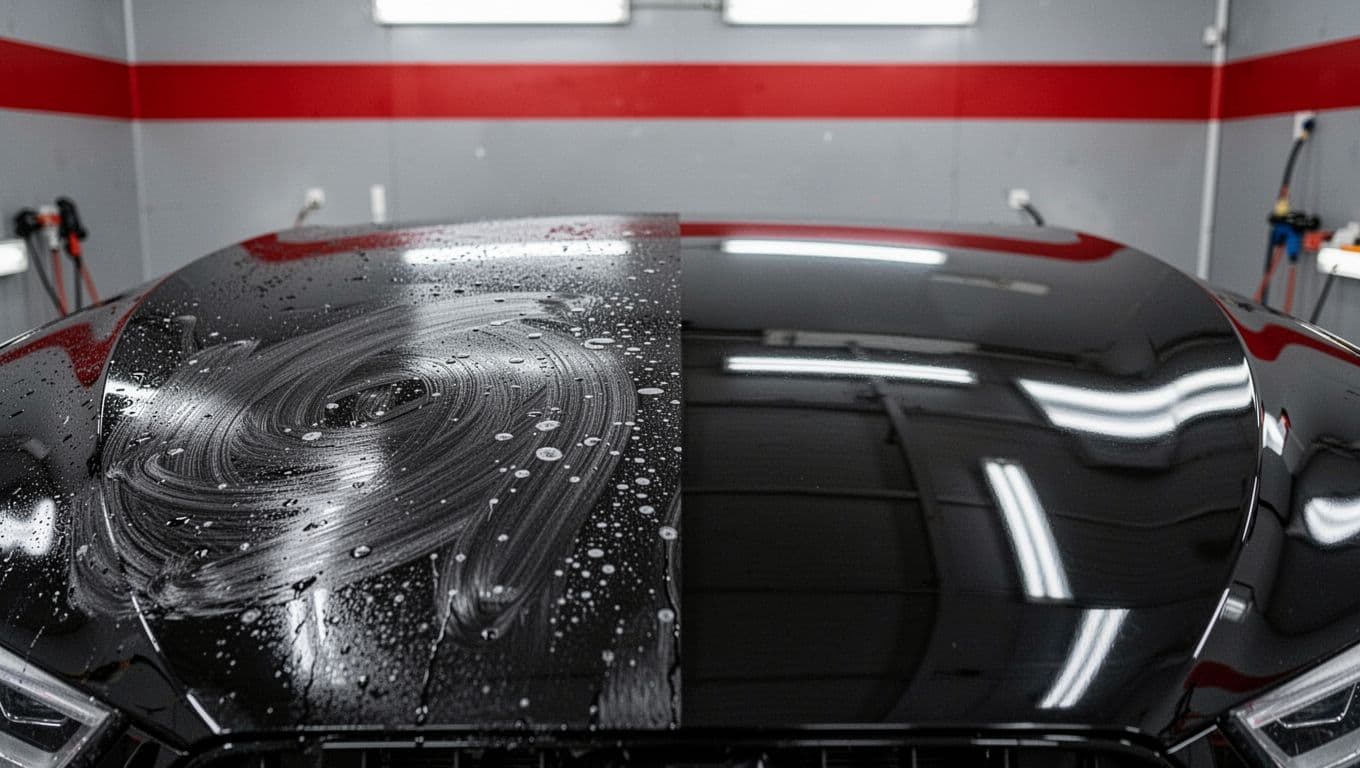
Polishing uses a mild abrasive product to refine the paint surface. It can remove or reduce light swirls, fine towel marks, mild haze, and shallow water-spot residue. It also improves gloss, color clarity, and the sharpness of reflections.
A hand polish is gentle but may produce limited defect removal. A machine polish is more consistent and can achieve a stronger finish with the correct pad and product. Neither option can safely remove a deep scratch simply because the panel looks shinier afterward.
Some products also contain fillers that make fine marks less visible for a short time. That can be useful for a quick appearance service, but it isn’t the same as removing the defect.
What correction adds
Paint correction usually includes more assessment and more control. The detailer may use a cutting compound to reduce heavier marks, followed by a finishing polish to restore clarity. A one-step correction can improve a lightly marked vehicle, while a multi-step correction is used when the paint needs more refinement.
The process may also include paint decontamination, pad changes, multiple test spots, and inspection between stages. Correction is suitable when the owner wants measurable improvement rather than shine alone.
When comparing paint correction vs polishing, consider the condition of the paint and your target result. A light polish may be the better service if it delivers the improvement you want while preserving more clear coat.
Common defects and the right treatment
Paint defects don’t all behave in the same way. Their depth, cause, and location determine whether cleaning, polishing, correction, or repainting is appropriate.
Swirl marks and light scratches
Swirl marks are fine circular or spiderweb-like lines that become obvious under sunlight or a bright inspection lamp. They often appear after poor washing, dirty drying towels, automatic brushes, or dusty wiping. Black and dark-colored vehicles show them quickly because the defects scatter reflected light.
A light machine polish can often reduce these marks significantly. If the swirls are shallow and the paint still has good clarity, a one-step correction may improve the appearance across the full vehicle.
Light scratches can receive the same treatment if they remain within the clear coat. Results depend on depth, location, and the amount of available paint. A detailer should inspect rather than promise complete removal from a photograph alone.
Oxidation and water spots
Oxidation often appears as faded, chalky, or cloudy paint. On older finishes, especially panels exposed to strong sun, the surface may lose color and reflection. Mild oxidation can improve after washing, decontamination, and polishing. Peeling or failed clear coat requires a different repair.
Water spots are easier to diagnose when you look closely. Some are mineral deposits sitting on top of the paint and may respond to safe chemical treatment or washing. Others are etched into the clear coat by minerals, heat, or contaminants. Etched spots may need polishing or correction.
The paint correction guide from Sea Auto Products outlines the importance of assessing defects before choosing a compound, polish, or pad.
Etching and deep scratches
Bird droppings, insect residue, tree sap, and hard-water deposits can etch the surface when they remain on hot paint. Cleaning the contamination early can prevent additional damage, but an existing outline may still need correction.
A deep scratch may require wet sanding, touch-up paint, or panel repair. Wet sanding removes clear coat faster than ordinary polishing and requires proper technique. It isn’t a sensible first step for most DIY detailers.
A simple treatment decision guide
Use the vehicle’s condition and your expected result to choose the service:
- Choose a light polish when the paint is generally glossy but has mild haze, fine swirls, or shallow marks.
- Choose one-step paint correction when defects cover several panels and you want stronger improvement without an aggressive multi-stage process.
- Choose multi-step correction when the finish has heavier swirls, oxidation, or etched spots and the paint has enough clear coat for careful refinement.
- Choose touch-up or repainting when scratches expose another layer, clear coat is peeling, or a chip has reached primer or metal.
A professional quote should explain the expected level of correction, not promise a perfect panel without inspecting it. Ask whether the service includes a hand polish, machine polishing, compound work, paint decontamination, and protection.
Prepare for treatment and protect the finish
Preparation affects the final result. Polishing dirty or gritty paint can create more marks, so the surface needs to be clean before any abrasive work begins.
Prepare the vehicle properly
Wash the vehicle in the shade, especially when the panels are hot. Use a clean wash mitt and a pH-balanced car shampoo. Rinse thoroughly, dry with a clean microfiber towel or air blower, and remove bonded contamination before polishing.
Inspect the paint after it is clean. A panel can look scratched when it is actually covered with road film or mineral residue. Cleaning first gives you a more accurate view of what needs correction.
Protect rubber trim and textured plastic before machine work. Polishing residue can dry into these surfaces and make cleanup harder. Masking edges can also reduce the risk of catching thin paint along body lines.
Use sensible aftercare
Paint correction doesn’t prevent future defects. It gives you a cleaner surface, but poor washing can bring new swirls back. Use clean wash media, separate wheel tools, and fresh drying towels. Avoid wiping dry dust from the paint whenever possible.
Wax, sealant, or a ceramic coating can help protect the finish from contamination and make maintenance easier. These products aren’t scratch-proof, and they don’t remove the need for careful washing. In Dubai, regular dust removal and washing on cool panels are especially helpful for maintaining a clear, glossy finish.
Safety advice for DIY detailers
DIY polishing can produce excellent results when the process is controlled. It can also damage paint when the product is too aggressive, the pad is dirty, or the machine stays in one place too long.
Start with the least aggressive method
Begin with a clean, mild polish and a finishing or polishing pad. Test a small area in an inconspicuous location. Work a limited section, wipe it clean, and inspect the finish under strong light before treating the whole vehicle.
A dual-action polisher is often a practical choice for beginners, but it still needs careful handling. Keep the pad moving, use moderate pressure, and avoid sharp edges, badges, trim, and panel gaps. A clean pad is important because trapped particles can create fresh scratches.
For a visual introduction, the beginner’s paint correction guide shows how product choice, pad selection, and inspection work together.
Know when to stop
Stop if the paint becomes unusually hot, the defect doesn’t improve after a reasonable test, or a color change appears on the pad. Those signs can indicate thin paint, damaged clear coat, or a finish that needs professional repair.
Don’t wet sand or use a heavy cutting compound without suitable training and equipment. A paint thickness gauge can provide useful information, but readings still require experience. When the risk is uncertain, preserving the original finish is better than chasing the last visible scratch.
Conclusion
The difference between paint correction and polishing comes down to purpose and aggressiveness. Polishing improves gloss and reduces light defects, while paint correction uses a more structured abrasive process to remove or reduce deeper clear-coat marks.
Not every defect can be safely removed, and aggressive correction uses valuable clear coat. Choose the mildest treatment that meets your expectations, prepare the vehicle carefully, and maintain the result with proper washing. The cleanest finish is the one that looks refreshed while keeping the paint protected for future care.
Get a price on detailing and surface protection
Shop #7, 44, 22nd Street, Ras Al Khor Industrial Area 2, open 24 hours. Tell us the car and we reply with a price and a time.
Would rather talk? Call +971 55 168 5050. Someone answers 24 hours.
See us first on Google
Google lets you choose the sites you want to see more of. Add Bud Car Wash as a preferred source and our car care guides show up more often in Top Stories and in Google’s AI answers.
Opens Google in a new tab. You can remove us again at any time.

Sammie O is the owner of Bud Car Wash, a 24 hour hand car wash and detailing shop at Shop #7, 44, 22nd Street, Ras Al Khor Industrial Area 2, Dubai. He writes the car care guides on this site based on work done in his own bay.
View All Articles