
Last updated 17 October 2026 by Sammie O, owner of Bud Car Wash in Ras Al Khor Industrial Area 2, Dubai.
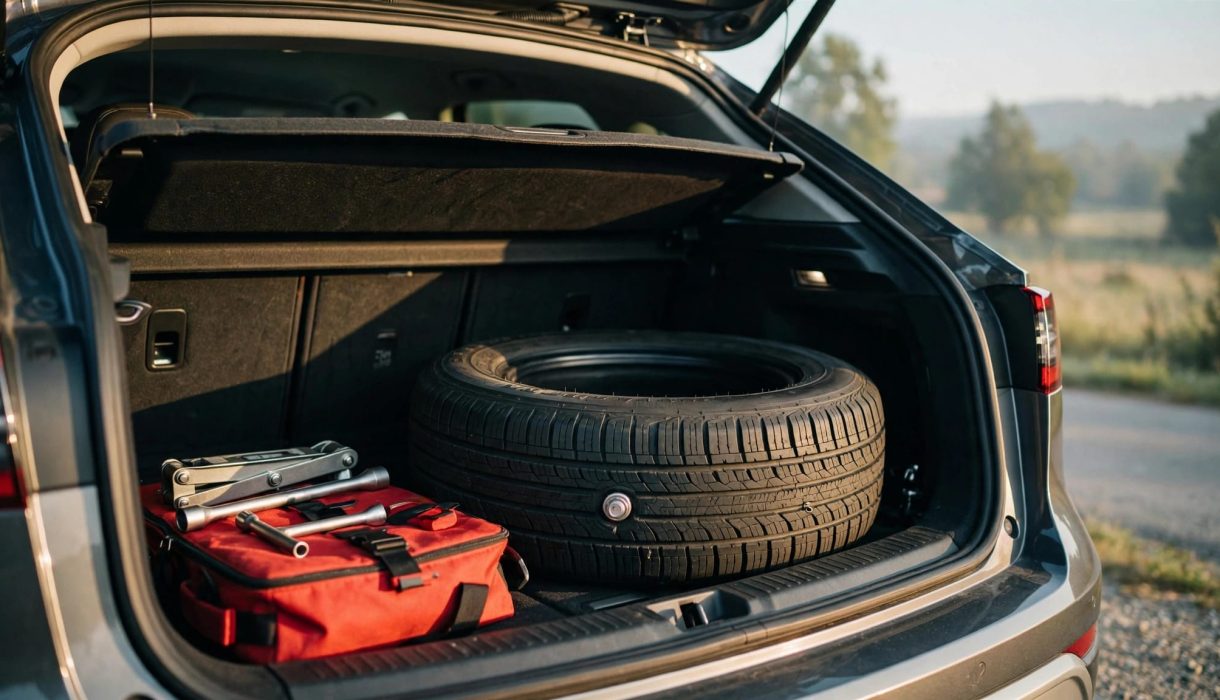
A spare tire check can help prevent a small tire problem from turning into a roadside delay. Before a long drive, confirm that your spare is the right type, properly inflated, and free from visible damage.
You’ll also want to know where it’s stored and make sure the jack and lug wrench are in the vehicle. A few minutes of preparation can make it easier to respond if a tire fails on the road.
Want us to do it instead?
We do tyre and wheel services at our Ras Al Khor bay, 24 hours a day. Fill this in and we reply with a price and a time. The message writes itself, so you only tap send.
Would rather talk? Call +971 55 168 5050. Someone answers 24 hours.
Know which spare is in your vehicle
Vehicles may carry a full-size spare or a smaller temporary spare. The type affects the pressure you need and how the spare is intended to be used, so identify it before checking the tire.

Full-size spare
A full-size spare is similar in size to the tires fitted to the vehicle. Some full-size spares match the other tires, while others are temporary spares with a different tread or wheel. Don’t assume that a similar-looking tire has the same pressure requirement as the regular tires.
Compact temporary spare
A compact spare, sometimes called a donut, is smaller and lighter than a standard tire. Its inflation pressure can be higher than the pressure used for the vehicle’s regular tires. The manual’s spare-tire instructions apply, even if the number seems unusually high.
Find the correct pressure for your spare
Use the vehicle owner’s manual for the recommended pressure and any spare-specific instructions. You may also find tire-pressure information on the Tire and Loading Information label on the driver’s-side door edge or door post. NHTSA’s TireWise tire safety guidance identifies those locations for recommended tire pressure.
Check whether the information applies to the spare or only to the original tires. The pressure printed on a tire’s sidewall can indicate its maximum pressure, which isn’t automatically the recommended pressure for your vehicle.
Why a compact spare may need more pressure
A compact spare can require a different pressure because it is built differently from a regular tire. For example, the 2024 Kia owner’s manual specifies 60 psi (420 kPa) for the compact spare described in that manual. Mastercraft also gives 60 psi (420 kPa) for T-type temporary spare tires in its spare tire care guidance.
Those are examples, not a universal setting for every compact spare. Use the instructions for your specific vehicle and tire. Kia’s compact spare instructions show why the vehicle manual matters.
Don’t use the regular tire pressure by default
The door label is a useful place to find pressure information, but the spare may have its own requirement. If the manual gives a separate spare pressure, use that figure rather than copying the pressure for the other tires.
Check the pressure while the tire is cold
Pressure readings are most useful when the tire is cold. NHTSA recommends checking all tires, including the spare, at least once a month when cold. A vehicle that hasn’t been driven for several hours gives you a more reliable reading than one that has just completed a long trip.
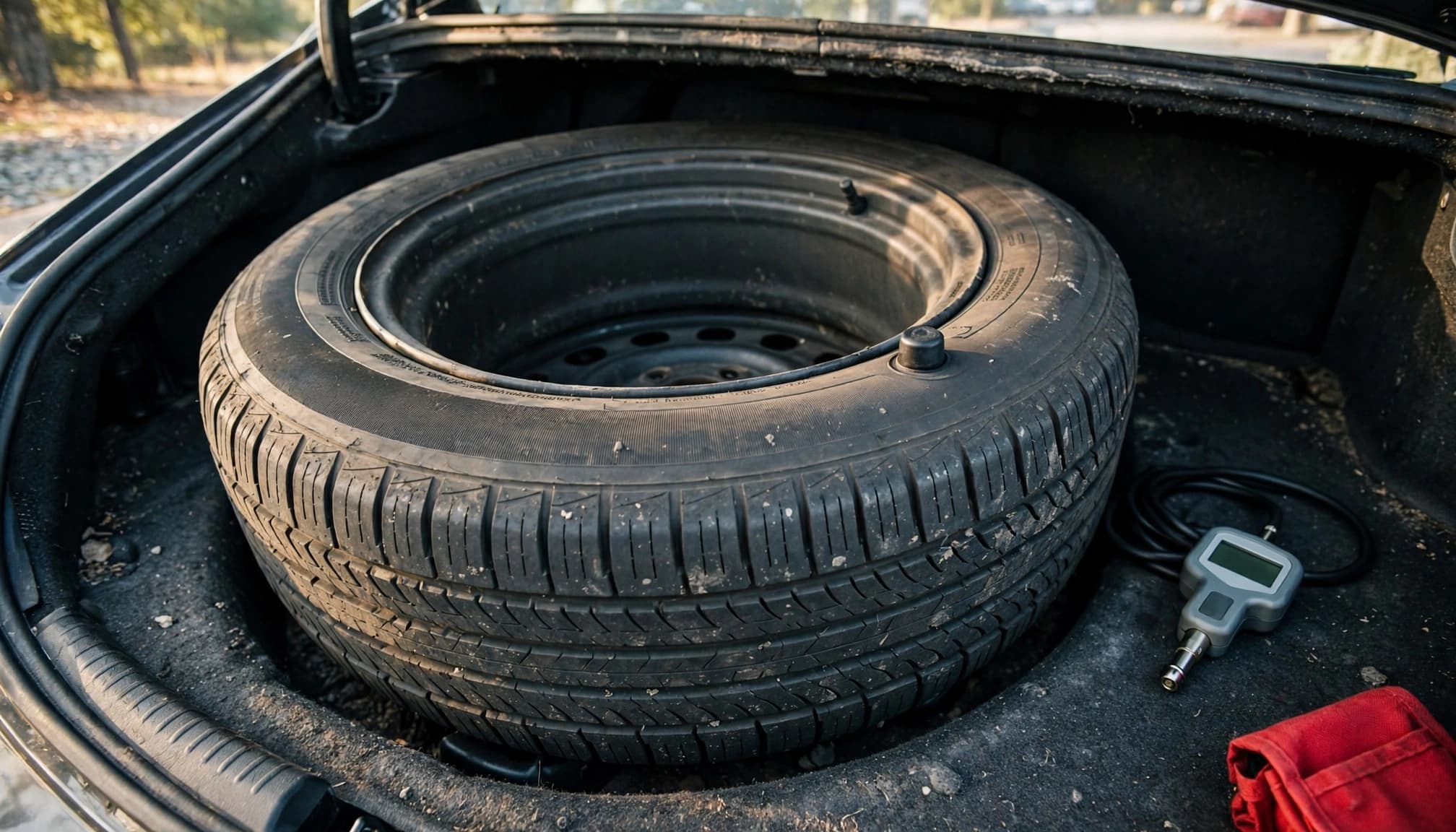
Use a reliable tire-pressure gauge. Remove the valve cap, press the gauge straight onto the valve stem, and read the result. If air escapes or the reading seems inconsistent, reposition the gauge and take another reading. Replace the cap when finished.
If the spare is below its specified pressure, add air and check again with the gauge. A portable inflator or service-station air pump can help, but continue to use the spare’s recommended figure as your target. If the tire is warm from driving, wait until it’s cold before adjusting pressure.
Inspect the tread and sidewalls
Correct pressure is only part of the check. Look over the visible tread and both sidewalls for cuts, cracks, bulges, punctures, or objects lodged in the rubber. Also check for severe or uneven tread wear.
A spare stored beneath the vehicle may collect dirt and debris. Wipe it off enough to inspect the rubber and locate the valve stem. If you can’t see the full tire while it’s mounted, remove it according to the vehicle’s instructions so you can examine it properly.
Do not plan a trip around a spare with visible damage. If you find a cut, bulge, or other concern, have the tire assessed by a qualified tire service before relying on it.
Confirm the spare and changing tools are accessible
A tire that’s in good condition won’t help if you can’t reach it. Find out whether the spare is in the trunk, under the vehicle, or in another storage area. Check how it’s released, and make sure luggage or other items won’t block access.
Inspect the jack and lug wrench as well. Confirm that both are present and stored in their proper places. Check the jack for visible damage and make sure the wrench fits the vehicle’s wheel fasteners. If the vehicle uses a locking wheel-nut key, include it with the tools.
Read the owner’s manual for instructions on where to position the jack and how to remove the spare. These details vary by vehicle. Knowing where the equipment is before you leave can save time when you need it.
Use this step-by-step spare tire checklist
Complete these checks before loading up or starting your trip:
- Locate the spare and identify whether it’s full-size or compact.
- Read the owner’s manual for the spare’s recommended pressure and use instructions.
- Check pressure with a gauge while the tire is cold.
- Add air if needed, then take another reading and replace the valve cap.
- Inspect the tread and sidewalls for visible damage or heavy wear.
- Confirm the jack, lug wrench, and any locking wheel-nut key are present and accessible.
- Secure the spare in its storage location before you set off.
The check can be quick, but each step covers a different issue. Pressure confirms that the tire is ready to support the vehicle, while the visual and equipment checks help you prepare for a roadside change.
Key takeaways
- Use the owner’s manual for the spare’s pressure and vehicle-specific instructions.
- Check pressure when the tire is cold, using a gauge rather than judging by appearance.
- Don’t assume a compact spare uses the same pressure as the regular tires.
- Inspect the tire, jack, and lug wrench before leaving.
Frequently asked questions
How often should I check my spare tire pressure?
NHTSA recommends checking all tires, including the spare, at least once a month when they’re cold. Check it again before a long drive, especially if the spare hasn’t been inspected recently.
Should I inflate a compact spare to 60 psi?
Only if that is the specified pressure for your spare. Some manuals and tire-care guidance list 60 psi (420 kPa) for particular compact or T-type spares, but that number doesn’t apply to every vehicle. Use the owner’s manual’s instruction for your spare.
Where do I find the recommended pressure?
Start with the owner’s manual. NHTSA also points drivers to the Tire and Loading Information label on the driver’s-side door edge or post. Use the spare-specific figure when the vehicle provides one.
Leave with a ready spare
A useful spare tire check covers more than the pressure reading. Identify the tire type, follow the correct pressure specification, inspect the rubber, and make sure the changing tools are ready.
Taking care of these details before your drive gives you a clearer plan if a tire problem interrupts the trip.
Get a price on tyre and wheel services
Shop #7, 44, 22nd Street, Ras Al Khor Industrial Area 2, open 24 hours. Tell us the car and we reply with a price and a time.
Would rather talk? Call +971 55 168 5050. Someone answers 24 hours.
See us first on Google
Google lets you choose the sites you want to see more of. Add Bud Car Wash as a preferred source and our car care guides show up more often in Top Stories and in Google’s AI answers.
Opens Google in a new tab. You can remove us again at any time.

Sammie O is the owner of Bud Car Wash, a 24 hour hand car wash and detailing shop at Shop #7, 44, 22nd Street, Ras Al Khor Industrial Area 2, Dubai. He writes the car care guides on this site based on work done in his own bay.
View All Articles